
Isaac Newton: Gravity, Genius and Hidden Knowledge
The Genius Who Revealed the Laws of the Universe
Skygaze explores the extraordinary discoveries, relentless curiosity, private investigations, and enduring legacy of the man who transformed humanity's understanding of motion, light, gravity, and the natural world.
From Solitary Child to Cambridge Scholar
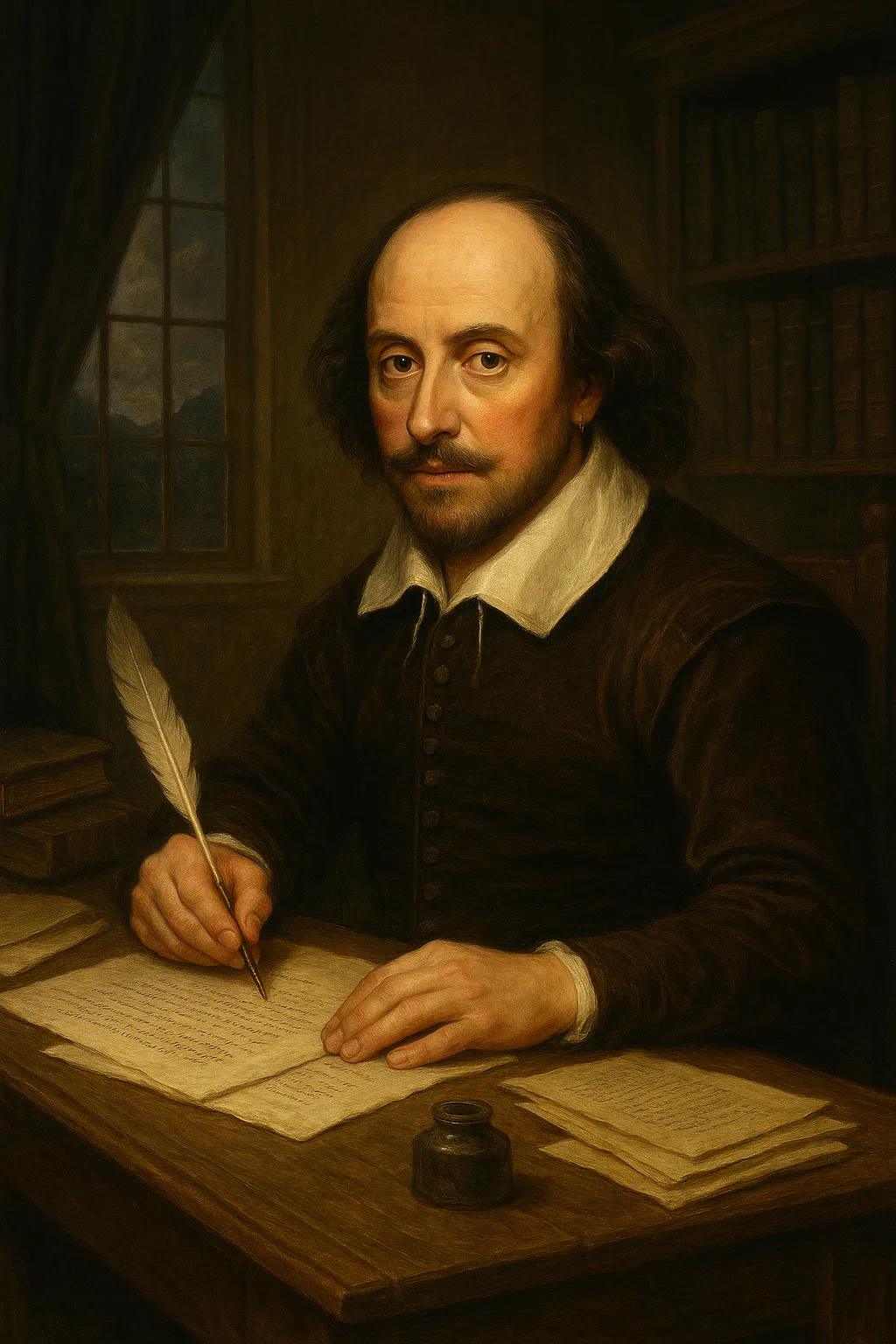
Isaac Newton was born prematurely on a farm in the English village of Woolsthorpe in 1643. His father had died before his birth, and Newton spent much of his childhood separated from his mother after she remarried. Quiet, intensely observant, and often solitary, he developed an early fascination with mechanical devices, models, sundials, and the behaviour of the natural world.
Newton entered Trinity College at the University of Cambridge in 1661. The university curriculum remained heavily influenced by ancient authorities, but Newton privately studied the newer ideas of thinkers such as Galileo, Johannes Kepler, Rene Descartes, and Robert Boyle. Rather than simply accepting established explanations, he began developing his own mathematical approach to nature.
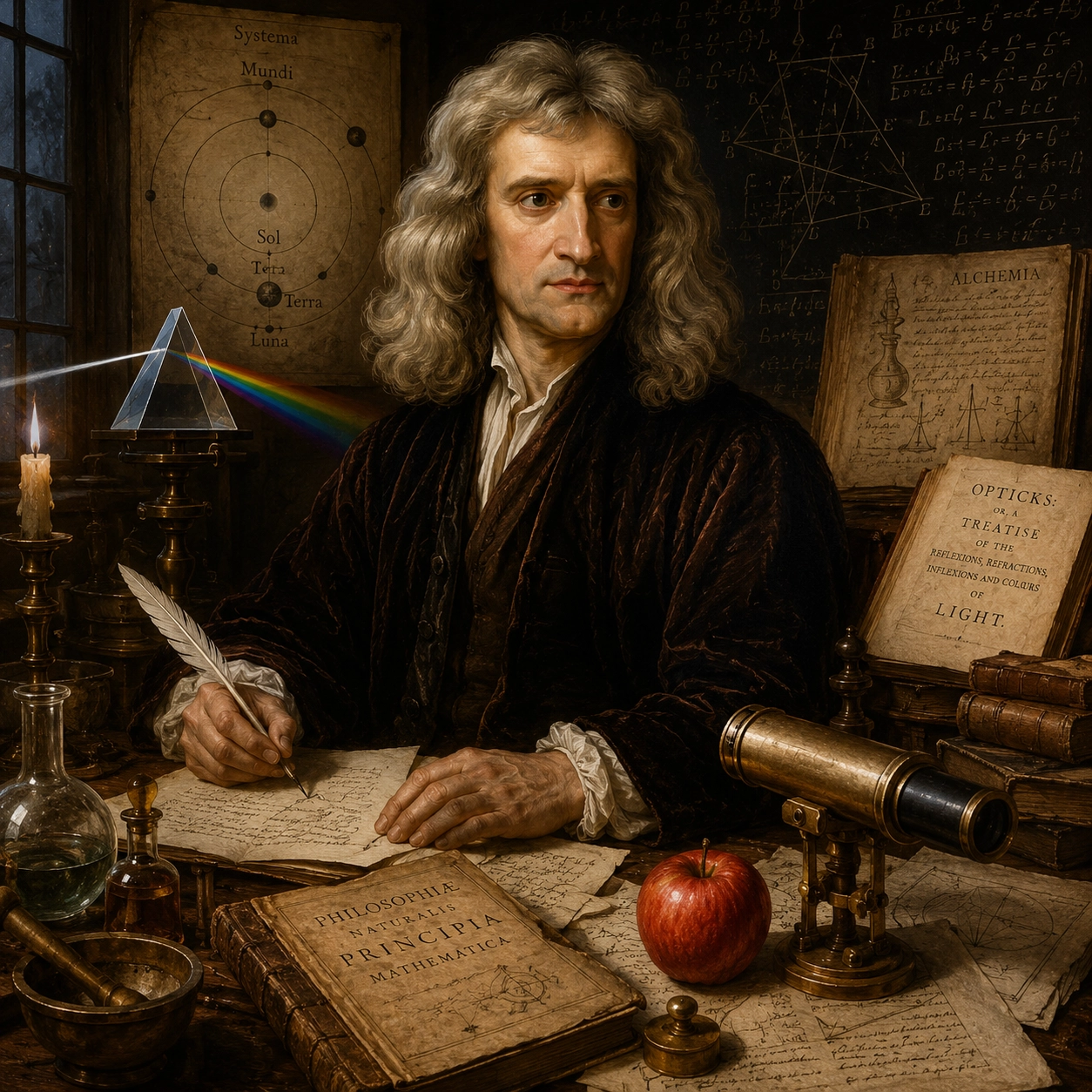
When plague forced Cambridge to close in 1665, Newton returned to Woolsthorpe. During this period of isolation, he developed foundational ideas concerning mathematics, motion, gravity, and light. The famous story of a falling apple may have been simplified over time, but Newton later recalled that observing an apple fall helped direct his thoughts toward the force drawing objects toward Earth.
Revealing the Laws of Motion and Gravity
Newton's greatest scientific work appeared in 1687 with the publication of Philosophiae Naturalis Principia Mathematica, usually known simply as the Principia. In it, he presented three laws of motion that explained how objects respond to forces, accelerate, and interact with one another.
Newton also described universal gravitation: the idea that every object with mass attracts every other object. The same underlying force that causes an apple to fall also governs the motion of the Moon, planets, and comets. This unified the physics of Earth and the heavens within one mathematical system, overturning the older assumption that celestial objects followed fundamentally different rules.
His work showed that the universe could be studied through observation, mathematics, and testable laws. Newtonian mechanics remained the dominant framework of physics for more than two centuries and continues to describe ordinary motion with remarkable accuracy. Consider how different existence would become in a world where gravity suddenly disappeared.
Light, Colour, Mathematics, and the Telescope
Newton's investigations extended far beyond gravity. Through experiments with glass prisms, he demonstrated that white light contains a spectrum of colours. Rather than believing the prism created colour, Newton showed that it separated colours already present within the light.
His discoveries helped establish the modern science of optics. To reduce the colour distortion found in conventional telescopes, Newton constructed a practical reflecting telescope that used mirrors instead of relying entirely on lenses. The compact instrument earned him recognition from the Royal Society and influenced later telescope design.
Newton also developed a powerful mathematical method he called fluxions, now recognized as a form of calculus. German mathematician Gottfried Wilhelm Leibniz developed calculus independently and published his system separately, leading to a bitter dispute over priority. Regardless of that controversy, calculus became essential to physics, engineering, astronomy, and modern science.
From Cambridge Professor to Master of the Royal Mint
In 1696, Newton left Cambridge to become Warden of the Royal Mint in London. The position was not merely ceremonial. England's currency was undergoing a major recoinage, while counterfeiting and the clipping of silver coins threatened public confidence in the monetary system.
Newton pursued counterfeiters with the same intensity he brought to scientific problems. He gathered testimony, studied criminal networks, and personally assisted prosecutions. In 1699, he became Master of the Royal Mint and remained in that influential position for the rest of his life.
Newton was elected president of the Royal Society in 1703 and was knighted in 1705. By the time of his death, he had become one of Europe's most celebrated intellectual figures, although his difficult temperament and fierce disputes with scientific rivals also contributed to a complicated personal reputation.
A Mind That Changed the Universe
Isaac Newton permanently changed how humanity understands nature. His laws of motion and gravitation made the movements of falling objects, orbiting moons, planets, and comets part of one coherent system. His work in optics transformed the study of light, while his mathematics supplied future scientists with essential tools for describing change and motion.
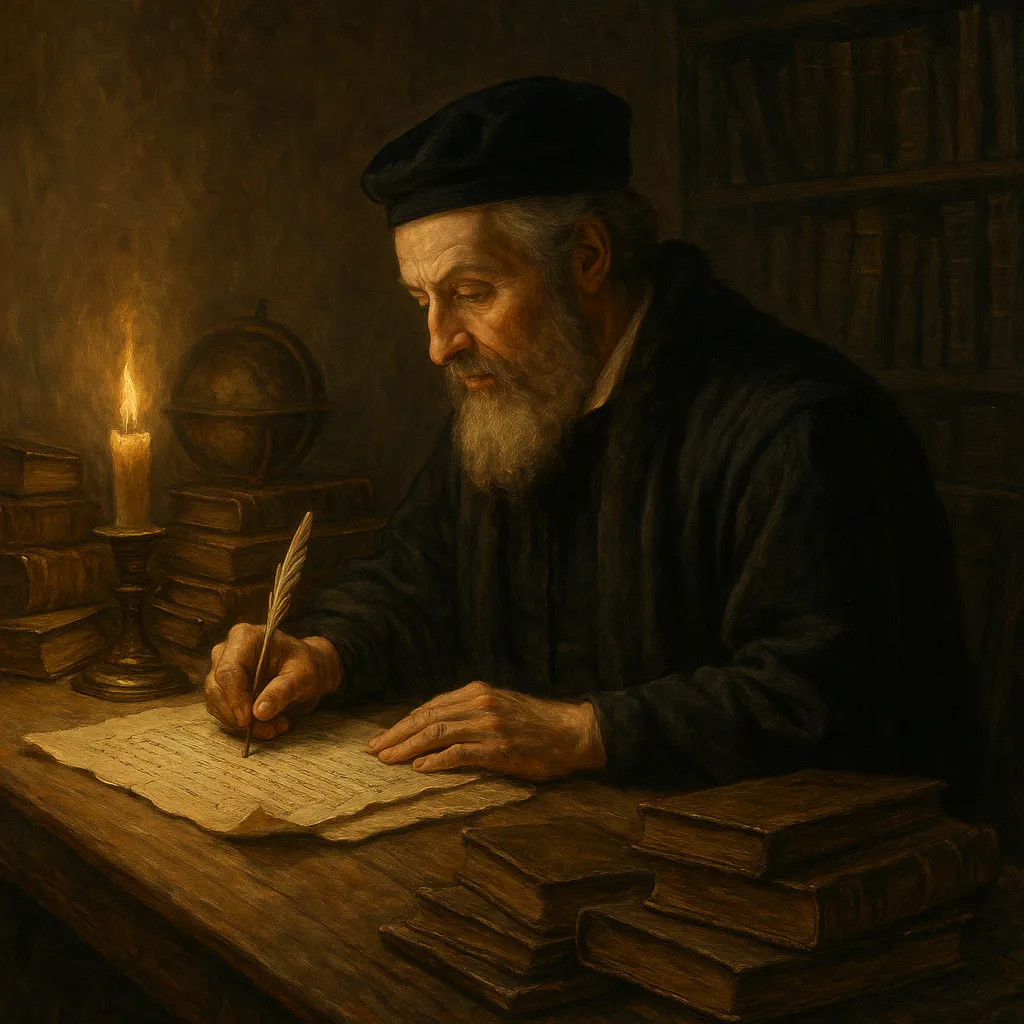
Yet the private Newton was even more complex than the scientific legend. His writings on alchemy, prophecy, theology, and ancient civilizations reveal a man who believed the universe contained hidden patterns waiting to be uncovered. These studies do not diminish his scientific accomplishments; they show how differently knowledge was organized during his era and how broad his search for truth truly was.
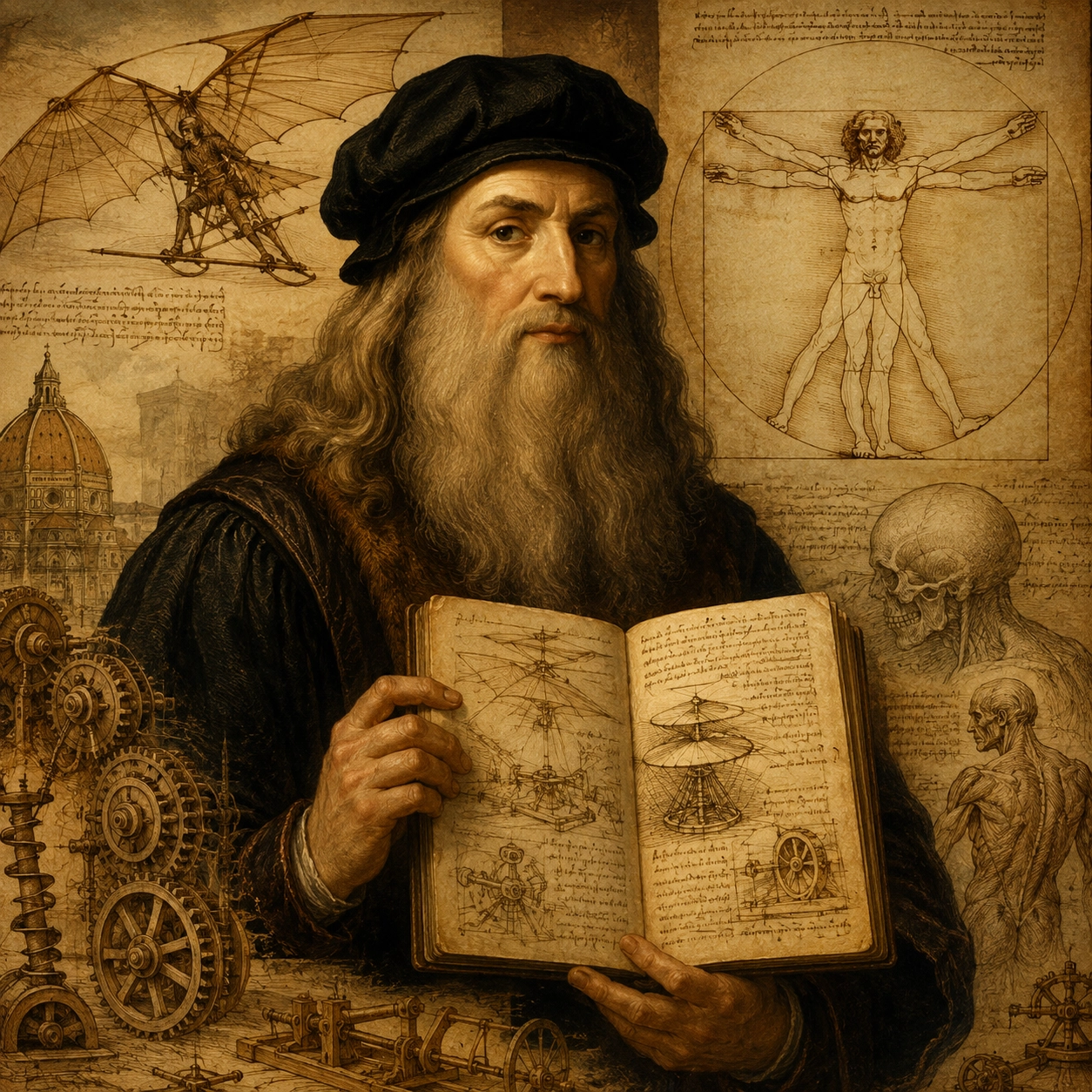
Like Leonardo da Vinci before him and Nikola Tesla after him, Newton possessed a curiosity that refused to remain within one discipline. Skygaze invites readers to remember him not merely as the man beneath the apple tree, but as a relentless investigator who sought the hidden laws connecting Earth, the heavens, matter, history, and belief.