
H. H. Holmes: Murder Castle, Crimes and Enduring Myths
The Criminal Behind the Murder Castle Legend
Skygaze explores the life, frauds, documented crimes, infamous Chicago building, and enduring myths surrounding one of America's most notorious nineteenth-century criminals.
From Medical Student to Master of Deception
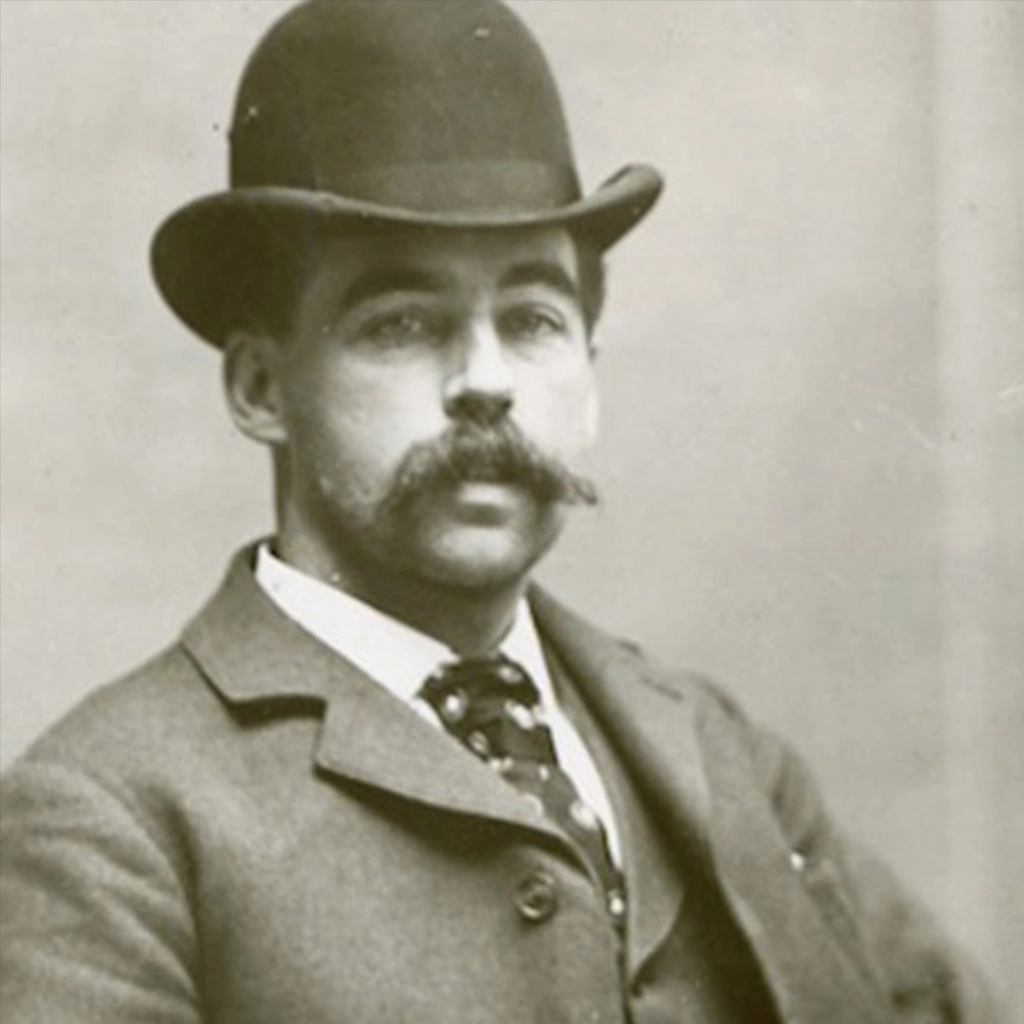
Herman Webster Mudgett was born in rural New Hampshire in 1861. Intelligent and ambitious, he studied medicine and graduated from the University of Michigan in 1884. His medical education gave him professional credibility, but it also became useful in a growing pattern of deception, insurance schemes, false identities, and financial fraud.
After moving through several cities, Mudgett settled in Chicago and began using the name Dr. H. H. Holmes. He found work at a pharmacy in the Englewood neighbourhood and eventually took control of the business. Charming when it suited him and persuasive with investors, employees, and romantic partners, Holmes repeatedly gained trust while hiding debts, previous marriages, and dishonest business dealings.
Fraud was central to his life. Holmes purchased goods on credit without paying suppliers, manipulated insurance policies, used aliases, and frequently abandoned obligations when they became inconvenient. His crimes were not the work of a mysterious supernatural villain, but of a skilled con artist who learned how easily confidence and respectability could be exploited.
Chicago's Infamous Murder Castle
During the late 1880s, Holmes constructed a large mixed-use building at the corner of 63rd and Wallace streets in Chicago. The ground floor contained shops, while the upper levels included rooms and apartments. He repeatedly changed builders and contractors during construction, apparently allowing him to avoid paying many of them and preventing any single worker from fully understanding the layout.
The building later became known as the Murder Castle. Newspapers described secret corridors, sealed rooms, hidden chutes, gas lines, and spaces supposedly designed for imprisonment and murder. Some unusual architectural features may have existed, but many of the most dramatic descriptions appeared only after Holmes became nationally notorious.
Despite its close association with the 1893 World's Columbian Exposition, evidence that Holmes operated it as a hotel filled with unsuspecting fair visitors is weak. The popular image of hundreds of tourists disappearing inside an elaborate death trap owes much to yellow journalism and later storytelling rather than firmly documented events.
The Documented Crimes
Several people connected with Holmes disappeared or died under suspicious circumstances, including women who worked for him or became involved in his personal and financial schemes. The precise number of his victims remains disputed because physical evidence was limited, records were incomplete, and Holmes himself repeatedly lied.
The crime that ultimately led to his conviction involved Benjamin Pitezel, a longtime associate in Holmes's fraudulent schemes. Holmes arranged an insurance plot in which Pitezel was supposed to fake his death so a policy could be collected. Instead, Pitezel was killed, and Holmes attempted to convince his family that the deception remained underway.
Holmes then travelled through several cities with three of Pitezel's children while their mother remained unaware of what had happened. Investigators later concluded that the children had also been killed. The search for them helped authorities uncover the full extent of Holmes's deception and provided some of the strongest evidence linking him to multiple murders.
Capture, Trial, and Execution
Holmes was arrested in Boston in November 1894 after authorities and the Pinkerton detective agency tracked his movements. Investigators initially focused on fraud and horse theft, but the disappearance of Benjamin Pitezel and his children soon transformed the case into a major murder investigation.
Holmes was tried in Philadelphia for Pitezel's murder in 1895. The prosecution presented evidence of the insurance scheme, Holmes's false explanations, and his efforts to conceal what had happened. He was convicted of first-degree murder and sentenced to death.
Before his execution, Holmes sold a sensational confession to a newspaper in which he claimed responsibility for twenty-seven deaths. The confession was deeply unreliable: several named victims were still alive, while other stories changed between tellings. Holmes was executed at Moyamensing Prison in Philadelphia on May 7, 1896.
How Many People Did Holmes Actually Kill?
Holmes is frequently called America's first serial killer and is sometimes credited with murdering as many as two hundred people. Neither description is as certain as it sounds. Other American serial murderers operated before him, and the two-hundred-victim estimate did not become widely repeated until decades after his death.
Modern researchers generally accept a much smaller number of probable victims. Holmes's confession cannot be trusted on its own, and investigators found far less physical evidence inside the Chicago building than popular accounts often suggest. Some disappearances remain suspicious, but suspicion is not the same as proof.
Separating Holmes's documented crimes from the legend does not make him innocent or harmless. Instead, it reveals something equally unsettling: a habitual fraudster and murderer deliberately helped manufacture his own mythology, while newspapers and later storytellers expanded it into an almost unbelievable tale.
A Criminal Transformed into an American Legend
H. H. Holmes remains one of the most recognizable names in American true crime. The combination of the Chicago World's Fair, the mysterious building, missing victims, insurance fraud, and Holmes's own shifting confessions created a story perfectly suited to sensational headlines.
Books, documentaries, podcasts, and television programs continue to portray Holmes as the architect of an elaborate murder hotel. Yet historical research increasingly challenges many of those familiar details, showing how quickly genuine crimes can become entangled with exaggeration and folklore.
Like the mystery surrounding Jack the Ripper, the Holmes story demonstrates how incomplete evidence and relentless publicity can transform a criminal case into an enduring cultural legend. Skygaze invites readers to examine what is documented, question what was embellished, and consider why the darkest version of a story is often the one history remembers.